
Why Mast Cells Wake You Between 2 and 4am
And why antihistamines only get you part of the way there

If you have MCAS, you know the pattern before I finish describing it.
You wake somewhere between 2 and 4am. Not groggy - alert. Heart going. Skin flushed, or itching, or just a whole-body sense of alarm with nothing to attach it to. You were asleep, and then you were completely awake, and there was no in-between.
Almost everything written about this stops at histamine. Histamine promotes wakefulness, mast cells release histamine, so block the histamine. That isn't wrong. But it doesn't explain why so many people take an H1 blocker at bedtime and still wake at 3am. And it doesn't explain the timing at all. Histamine doesn't keep a schedule.
Two things are missing from the histamine story.
The first is that a mast cell doesn't release one compound. It releases roughly a dozen sleep-relevant ones, on three different timescales, from a single event - which means a flare at 2am is still doing something to your sleep at 4am, through a different mechanism than the one that woke you.
The second is that mast cells have their own circadian clock. Not a metaphor - clock genes, running inside the cell, calibrated to make it reactive during the window you keep waking up in.
Let's take those in order.
One degranulation, three waves, one night
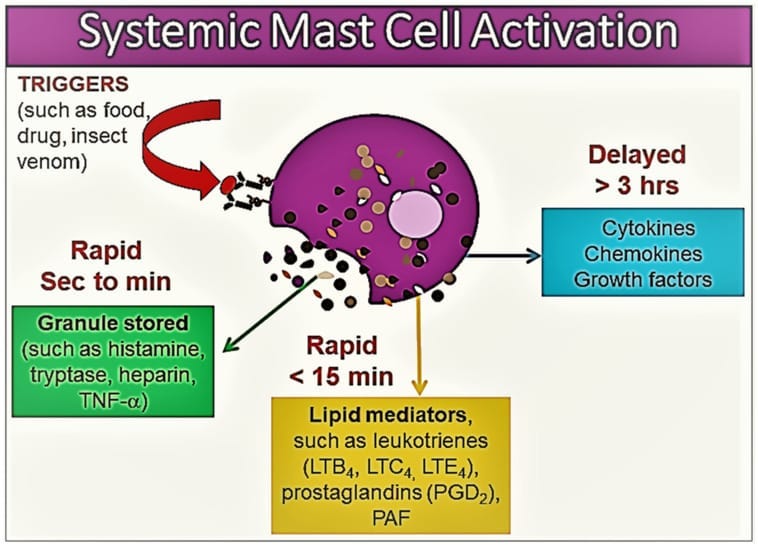
When a mast cell degranulates, it empties in stages.
Within seconds, the preformed contents of the granules are out: histamine, serotonin, tryptase, TNF-alpha. These are pre-made and stored, waiting. This is the wave you feel - the flush, the heart rate, the abrupt arousal.
Over the next 5 to 30 minutes, the lipid mediators arrive. These aren't stored; they're synthesized on demand. Prostaglandin D2 and prostaglandin E2 are the relevant pair, and they pull in opposite directions - PGD2 is somnogenic, PGE2 promotes wakefulness. Mast cells are a primary peripheral source of PGD2 during activation, so the net effect on any given night depends on which prostaglandin ends up dominant in the CNS compartment (Valent et al., 2022).
Over the following 1 to 24 hours, the cytokines: IL-6, IL-1beta. These have to be transcribed and translated, so they arrive long after the event that triggered them (Molderings et al., 2011; Valent et al., 2022).
Sit with the timeline.
A degranulation event at 2am is disrupting your sleep at 2:05, at 2:30, and at 4:00 - through three different mechanisms. And the last wave is still circulating the next morning. In MCAS cohorts, elevated serum IL-6 tracks with a neuropsychiatric profile that includes cognitive impairment and fatigue (Valent et al., 2022), and IL-6 is separately associated with reduced slow-wave sleep and unrefreshing sleep. That's the mechanism behind waking up unrestored after a night you technically slept through.
Three other things in that cascade deserve more attention than they get.
Serotonin. Up to 20-40% of hippocampal serotonin may be mast cell-derived. Mast cell-deficient mice show hippocampal serotonin deficits that neuronal sources do not fully compensate for (Nautiyal et al., 2012). Mast cell activation isn't only adding inflammatory mediators to the system - it's moving a neurotransmitter that sleep architecture depends on.
Tryptase, which builds itself an amplifier. Tryptase activates PAR-2 receptors on sensory nerves and neighboring immune cells, and that signaling drives up to a 6.7-fold increase in local mast cell numbers through the PAR-2/ICAM-1 pathway (Liu et al., 2016). More mast cells in the tissue means more mediator on the next release. This is why a bad night can turn into a bad week - the system recruits.
The reason antihistamines underperform. If histamine were the whole story, blocking H1 would fix the night. But IL-6 is reducing slow-wave sleep through its own pathway, tryptase is sustaining neurogenic inflammation through PAR-2, and PGE2 is promoting wakefulness independently of any histamine receptor. Block one and the other three waves keep running. The incomplete response isn't a dosing failure - it's a coverage problem.
So why always 2am?
The three-wave cascade explains what wakes you. It doesn't explain when - and the when is the strangest thing about MCAS-related sleep disruption.
People don't describe random nocturnal flares. They describe a window. Ask a room of people with MCAS when they wake and you'll hear the same two-hour range, over and over, with a consistency that shouldn't happen if this were simply a matter of accumulated triggers or an unlucky immune system.
That regularity has to come from somewhere. Something in this system is keeping time.
It turns out five separate mechanisms converge on that window - and I have not found them assembled anywhere as a single account.
Everything below is for paid subscribers.
What's behind it: the five circadian mechanisms that collide between 2 and 4am - the mast cell's own clock gene, cortisol's nadir lifting the brake, and pre-dawn CRH firing directly at mast cells inside your brain. Then the evidence that brain-resident mast cells regulate sleep independently of anything happening in your bloodstream, why the MCAS/EDS/POTS triad compounds all of it, and the restless legs finding that standard iron testing will miss.
One thing worth saying plainly: that 2-4am synthesis isn't published anywhere as a single study. I built it by reading five separate research lines and putting them side by side. Doing that properly - and telling you honestly where the evidence is strong and where it's inference - is what your subscription pays for.